I was sitting at a stop light the other day. I was making the best of my honey do list running errands by motorcycle on a beautiful day. The light changed for traffic crossing my path and the cars took off. The first car pulled out at a reasonable speed, the second seemed to be tailgating a bit, and the third was apparently in a hurry or marching to another drummer. It accelerated rapidly and plowed into the second car, which in turn ran into the first. Sometimes, the building process can be like this. No, I’m not saying it’s a car wreck, but there are a lot of parties involved in the process. Not unlike many processes, each party observes the same information, but does not always interpret it the same way.
The process of Architecture is an effort to define and communicate an intended result essentially from drawings and written directions. The construction process is the effort to create this drawn item. It is necessary to provide the proper information and direction to prevent any crashes. The greater the communication and understanding between parties, the better they see and perceive the same information, the less likely there are any nicks, dings, or crashes. An integrated Design/Build process fosters that communication resulting in a smoother process and mitigates the likelihood of mistakes.
Oh yeah, the second two cars stopped, but the first drove off with its bumper dragging. I'm not sure it ever stopped.

Friday, July 12, 2013


Sunday, June 23, 2013
Giving Back
Some of the BuildSense team recently attended the annual AIA
(American Institute of Architects) Conference in Denver. The focus of many of
the lectures was on community focused design. The question arises as to how
architects use their training and solution based thinking to give back to their
community and beyond?
It makes me proud to know that this is nothing new to BuildSense.
Our recently updated website includes a new “community” page (http://www.buildsense.com/community.aspx)
that highlights work that we do to give back to our local community, students,
and non-profits, as well as globally to impoverished areas in Nicaragua. These
successful projects demonstrate how providing more thoughtful design and
execution benefits the users as well as the designers and builders. A day, a
week, or a summer semester of time proves to be an investment with great
return. Perhaps our work for others in addition to our regular work flow was a
reason we were recently voted INDY Week’s Best Green Builder and runner up Best
Green Architect for the Triangle.
While recognition is nice and appreciated, it falls short of the feeling
of accomplishment from helping those in need by doing what we do best. We are
currently teaching the Summer Design/Build Studio for NC State’s School of
Architecture. The students are working on a floating classroom for the HUB
Farm; a teaching farm underway for the Durham Public Schools behind Eno Valley
Elementary School. There is nothing better than leading a project for students
by students. The learning on the front end will forever result in continued
learning for younger students upon completion. Please stay tuned for more on
this as the HUB Farm, Durham Public Schools, NCSU, our collaborative team are
depending on donations to help support our work efforts.
 |
| Current rendering of the student project for Durham Public Schools' HUB Farm. If you have any interest in providing financial support to this project and the HUB Farm in general, please contact us and we will put you in touch with the proper contacts at Durham Public Schools. Thanks for your support. |
Sunday, June 2, 2013
The Consequences of Design Decisions
If you make what you design, you receive the most brutally direct feedback about your design decisions. This is true from cooking to ceramics to furniture making to the construction of buildings. Sometimes the feedback is immediate. Such is the case when throwing a pot or making soup for example. Sometimes the feedback is longer term, as was the case for building a masonry cathedral without buttresses.
I’ve had the experience of throwing a pot (incorrectly) and literally wearing my mistake. Fortunately, I have not built an unreinforced masonry gothic cathedral without buttresses. People did, though, and learned (in a catastrophic and quite memorable way) about their mistake. From these failures and this feedback, designers and builders learned about lateral forces and wind loads. From successes and failures, ceramicists learn how to improve their craft. From successes and failures, cooks create tastier recipes. From successes and failures, designers and builders learn to make much better buildings.
There are two keys to this process. One: jump into the design-make-design loop. Two: listen to the feedback. There is no better way to learn. This is the second week of a design-build studio at the NCSU College of Design that we have taught for several years. This is our way of introducing the design-make-design loop to students at a critical time in their development as designers and/or builders. It is a step that is too often passed by in architectural education. The difficulty with a designed connection becomes clear with the execution of that connection. The information may be intellectually clear, but it does not stick until the designer directly experiences the ramifications of construction. They take the “make” information back to the “design” loop and will never design that same construction difficulty again. During the next week of design intensity, dozens of full-scale details will be constructed in order that the design-make-design loop can be complete before final design decisions are made. Without fail, the students find these studios to be intense, difficult, stressful, sweaty (building in August in North Carolina), and incredibly valuable.
This summer the studio is building a floating outdoor classroom for the Durham Public School’s Hub Farm. If you have any interest in supporting this studio and this project, please contact me, Randall Lanou, at rlanou@buildsense.com.
Monday, May 27, 2013
Take a Lesson from Durham on Moving Forward Through the Power of Compromise
Last week, Preservation Durham, The Durham City Council, Greenfire Development, and East-West Partners came to a mutually agreeable determination for the future of the Liberty Warehouse. In a day and age where lack of compromise has resulted in stagnation, I wish to commend all parties on working together to achieve what is a win/win for Durham, Preservationists, and the blossoming Central Park District.
I am a devoted Preservationist who has processed dozens of the Secretary of Interior’s applications and produced projects recognized with Capital Area Preservation’s Anthemion Award and Preservation Durham’s Pyne Award. I am an enthusiastic modernist who believes we should not build replicas of 200-year-old structures with modern technology that begs to be used in new and different ways (potentially of its own historic significance in 200 years). I am an environmentalist that believes in the use of regionally appropriate design and materials to best prepare a building for a long and healthy lifespan. I am a Durham Resident and Building Owner in Durham Central Park. I firmly believe that “old” does not define “contributing historic significance” and think they often get confused. I believe that bringing together smart and experienced individuals on a case-by-case basis yields far better results than blanket statements of what is allowed and disallowed.
That’s the interesting dilemma of Liberty Warehouse. There’s more significance to its former use and interior structure than to its exterior appeal and interaction with the adjacent properties. Without compromise, it would likely have sat stagnant, financially prohibitive from development. With the stipulations as laid out among the participants (see http://myemail.constantcontact.com/Liberty-Warehouse-Update.html?soid=1112457037077&aid=1RUD5hDYI3A), it is possible that we can have the best of all worlds. With thoughtful design and execution, it is possible to integrate the greatest strengths of its history with the greatest strengths of our blossoming Durham. If East-West Partners see these parameters as guidelines to excellence and not hindrances to be worked around, that should be the case. Let’s keep an eye on the progress to help make it so.
What's HERS and why is important to your home?
“HERS,” usually a word we use as a pronoun, is a prominent acronym in the green home world. HERS stands for Home Energy Rating System, a scoring system where a score of 0 represents a net zero energy home and score of 100 represents a standard code minimum new home. A HERS score is essentially the miles per gallon of your home. Most existing homes have a HERS score around 130 or more. Each point is a 1% difference in energy consumption from the new home baseline, so most existing homes are 30% less energy efficient than new homes. A score of 70-80 is not hard to achieve, so that means your new home could easily be up to 50% more energy efficient than your existing home! The difference would show in your energy bills. BuildSense homes typically have a HERS score of somewhere from 50-70 based on our clients choices. A typical BuildSense home of 2000 square feet has average monthly energy bills of less than $70. Where do your energy bills stand?
A HERS Rater will usually determine the score of a home using the plans, a software program called REM/Rate, and a few diagnostic tests. REM/Rate is an energy analysis program that calculates the energy consumption and costs of a home. A test called duct blasting uses pressure to determine any air leakage in the duct system and a blower door test helps identify air filtration issues of the house. The Rater will use all this information to form the HERS score. As more homes are scored, HERS will be an important part of directly comparing homes.
A HERS score is a basic requirement of most green building certifications. BuildSense’s corporate commitment is certify all homes by both the National Green Building Standard and ENERGY STAR. Besides using the HERS, a quality builder utilizing the National Green Building Standard will assure that the other systems in your home are coordinated with the air tightness and limited energy use to ensure you have a healthy and comfortable indoor environment, limit use of additional resources, and reduce the demand for long term home maintenance.
You should insist on a HERS score if you are looking at purchasing a home. In the coming years it will likely be a requirement in the real estate industry in order to clearly understand the costs associated with ownership of a particular home.
 |
| HERS Index Chart |
 |
| A blower door test pressurizes your home to reveal how much air is "leaking" through the various "cracks" and "holes" in your home. |
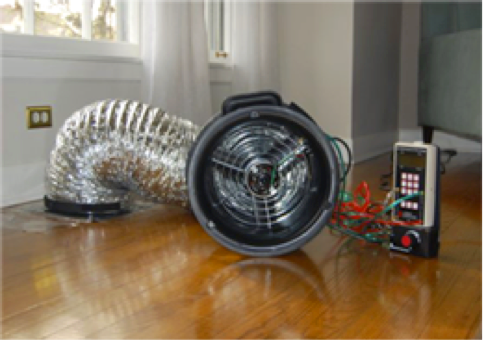 |
| A duct blast test pressurizes your duct work to reveal if it is "leaking"and providing conditioned air to areas like your attic or crawlspace. |
Friday, May 10, 2013
Overhangs Not Overrated
I've been a potential homebuyer for a while now and I must admit that I love house hunting. My wife and I find delight in seeking out a potential new home and partaking in a short-lived design charrette with each home we tour. Upon entering the home-for-sale we both begin mental demolition of spaces that seem unappealing. 70’s wood paneling – gone! Canary yellow linoleum - gone! Like all potential homebuyers, we begin mentally moving in and making the space our own. In the search for new homes, we both have our quirks, our wishes, and our deal breakers. The first thing my wife looks at are the rational things like cost, location, and amenities. Good thinking. I tend to focus on the “bones” of the home. How well was it built? How’s it going to last? What kind of maintenance will it require? And, of course, is there ample space for a man room dedicated to sporting events, beer, and company? Along the exterior, my eyes immediately seek the roofline in search of generous overhangs with character. With a good roofline, the house has potential. It may be a dog on the inside with bad flooring and poorly colored walls, but at least the outside structure is correct.
In my current neighborhood, overhangs are hard to come by. And like most new developments, the neighborhood and newly constructed homes don’t seem to have many of the desirable characteristics of homes from our past (i.e. overhangs, inviting front porches, established trees, signs of hope). The typical roof in my neighborhood provides a 12" overhang, which makes the home appear bare and banal. In the world of Residential Architecture and fine home building, correctly sized and proportioned overhangs are one element that Architects, Designers, and Craftsmen all understand to convey quality and craftsmanship. Although a roof with deep overhangs can increase material and labor costs, these costs are typically minor as compared to the total budget, and the benefits of good roof details are a wise investment. Beyond delivering aesthetics and curb appeal to a home, their main purpose is to protect the entire home, which after all is your single biggest financial asset. Overhangs keep water away from your siding, windows, and building foundation, and keep you from dealing with numerous moisture issues over the long term. They are shading devices, which can block out unwanted solar heat gain during the hot summer. They will also assist your mechanical systems by reducing the need for cooling, resulting in lowering your utility costs.
Good overhangs are simply good affordable fundamentals of architecture. They’re a sign of design and purpose. They should be valued and upheld, not overlooked and certainly never traded for a home with stainless steel appliances or trendy granite surfaces.
Friday, May 3, 2013
Triangle Clean Cities Coalition
BuildSense has been participating as an active member of the Triangle Clean Cities Coalition for about one year. Your reaction to this may be, "What's that?". Triangle Clean Cities Coalition works with stakeholders across the Triangle area to reduce the use of petroleum based fuel. There are over 100 similar "Clean Cities" groups across the country. They are also the group from whom we won a grant for assistance to convert the majority of our fleet to run on Compressed Natural Gas (CNG).
The Department of Energy requires that Clean Cities programs be re-designated every three years. Essentially they have to prove they are making a difference. The evaluation took place in March. In order to achieve re-designation, coalition staff completed a six-month evaluation process, culminating with a presentation to Department of Energy officials and representatives from the National Renewable Energy Laboratory and the National Energy Technology Laboratory. Triangle Clean Cities Coalition Coordinator Lacey Jane Wolfe made the presentation, along with Chairperson Jeff Barghout, Vice Chairperson Jeff Andre (of BuildSense), and Advanced Energy.
"Triangle Clean Cities Coalition has a tremendous impact not just in the Research Triangle area but also as a state leader encouraging fleets to adopt alternative fuels, electric vehicles and other petroleum displacement strategies," Barghout stated during the presentation. As part of the re-designation process, more than 40 stakeholders agreed to speak with Department of Energy representatives. Those contacted were asked about the coalition's strengths and weaknesses, and that information will be incorporated into the coalition's operating plans moving forward.
Preliminary data from the annual report suggest that our coalition displaced more than 3.3 million gallons of gasoline equivalent in 2012. This is a 28 percent increase in offset fuels from the previous year. The recent re-designation will allow Triangle Clean Cities Coalition to continue their efforts to reduce petroleum dependence in the Greater Triangle Area for years to come.
The BuildSense CNG operation, while small, is a measurable part of that effort. We undertook this project to align our vehicle use with our overall corporate philosophy, reducing our environmental impact whenever the opportunity arises. I expect that BuildSense will continue to be an active participant in the Triangle Clean Cities Coalition for many years.

Subscribe to:
Posts (Atom)