I recently spent a few days with my family vacationing on a National Seashore. Our cabins were the only structures around. There were no roads, no huge beach houses stacked on top of each other, and no tacky beach shops. It was just the sand and the sea. We brought a few things to pass the time: books, cards, a few beach toys, (and sure, we did take our phones). We found ourselves not needing any of that. The natural beauty of the place was enough to keep us “entertained”. Between swimming in the ocean, looking for shells, and just sitting on the beach taking in our surroundings, there was no need for anything else. Initially I was afraid we had not brought enough to keep the kids entertained, but they too kept very busy and had a great time.
Its amazing how we can be “entertained” by so little, how sensory pleasing the natural environment can be, and even kids recognize this in their own way. Even with all of available forms of entertainment these days, sometimes it’s the simple things that can grasp our attention and leave a lasting impression. There are just some places and experiences that will never be able to be replicated or manufactured. These beautiful places are one of the many reasons why building and living sustainably is important to me. Obviously through the process of building we will consume resources. That is why we strive to tread as lightly as possible when we build. Also we have the science to build smarter and more efficiently, both during construction and for the life of the home. So a new building that is constructed using the proper techniques and systems will conserve resources now and through the future, be better for the environment, and save the owners money over the lifetime of the home.
I realize that we all can’t afford to build new energy efficient homes, walk to work, or drive a Tesla, but we can all take steps no matter how small to make a difference. The benefits of taking these steps will be felt, not only by us, but for the generations to follow. Protecting beautiful natural places, whether across the ocean or in our backyard is something we must do for now and the future. And the next time you are at the beach, or in the mountains, or just in your backyard take a moment and be “entertained” by your surroundings.

Friday, September 27, 2013


Thursday, September 12, 2013
Pocket Neighborhoods - Stronger Communities
Not long ago I attended an inspiring lecture by Architect Ross Chapin who is widely known for his work regarding pocket neighborhoods. He’s made a career from providing meaningful, close-knit communities for people that seek a common interest in what they call home. Ross Chapin’s pocket neighborhood designs are typically clustered groups of houses centered around “shared” spaces such as gardens and courtyards with pedestrian streets and paths that link the development together. The emphasis of these designs is to bring “community” and connectivity to neighbors.
There is a surreal simplicity to the village like design. The images he shared conveyed cozy neighborhoods with vibrant landscapes. Low fences disappear into lush gardens and meandering walkways reveal an inviting chair on the porch of a bungalow. One consistent and pleasing theme that resonated throughout each planned development was to create a neighborhood inside a neighborhood that all people share and call home.
These are the type of design principles that can strengthen the existing fabric of our local communities, especially in predetermined neighborhoods. Some of our local neighborhoods have community gardens, dog parks, playgrounds and even farmers’ markets. Chapin would say these are ideal communal places around which to focus our residential planning. This kind of development ideology can certainly help to better our neighborhoods, which in turn strengthens our communities. These strategies should be part of our local zoning. Get involved with your local officials to discuss creating small intimate neighborhoods. Begin this conversation and subsequently communities will emerge.
Friday, September 6, 2013
Best Project Results
Early one morning a few weeks ago, I drove to one of our projects that was nearing completion. While we had a hot summer, this particular morning was delightfully cool and refreshing. We had built a considerable addition and performed thorough renovation to this 1874 home and our clients had recently moved in. Approaching the rural setting, I began to see subtle changes. Our job site sign and marketing box were gone and a new mailbox was installed. Turning into the driveway, I first noticed final gravel had been applied and fresh grass was growing from a centered strip. I then realized the monster steel storage container had been removed. I drove the length of the drive and delightfully the dumpster and porta-potty were gone too. No building materials in the yard, no piles of soil or mulch. Everywhere I looked I just saw a spring like setting of tall oaks and freshly planted everything. And of course the house looked beautiful. Everything was complete and the bright new paint beckoned you to stop and admire the results. On the wrap around porch I spotted our client and her young toddler lounging in a porch swing. It nearly brought tears to my eyes. Well ok, it did. My first thought was, "this is why we do this". I mean we don't often see the way our clients live in their homes. But if you wanted to see a best use of one of our projects, this was it. I asked if I could take a photo and was granted permission. As I sat down on the deck, I joked that they must be happy we were down to a couple of punch list items and she would be rid of us. Sweetly and sentimentally she suggested that in fact they might miss us a bit. I knew we were going to miss this home and their family. We grow attached to our clients. This was a fun project and somewhat surprising for the folks who toured it during the recent green home builders tour. BuildSense is well known for our modern designs. Yet every so often we get to restore life to a grand old home and prepare it for the next hundred years and the next generations of occupants. I think I will keep my eye on this one.
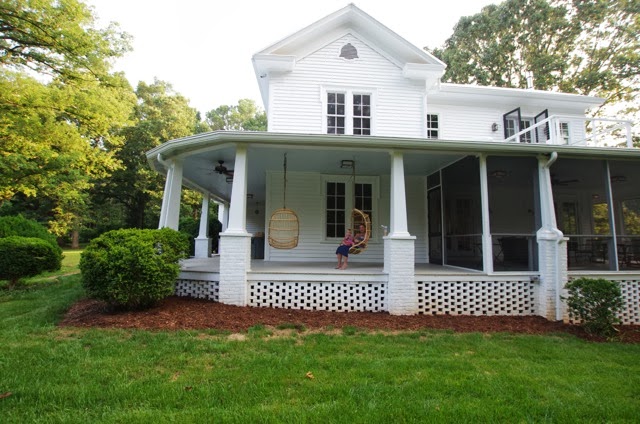 | |
| A peaceful morning on the porch swing for our client and their toddler. Real satisfaction comes when we know our clients truly enjoy their homes. |
Friday, August 30, 2013
Design Build Client Empathy
For most of my adult life I have designed and built residential projects (I would prefer not to mention the total number of years at this endeavor). We have watched our clients struggle with design decisions, with appraisals, with banks, with schedules, and with compromises. We've witnessed our client's exhilaration with a completed project, a beautifully executed detail, or a space that feels just right. We've shared the joy and helped smooth the rough spots.
I thought I completely understood these feelings. Right up until my wife and I started to design and build our own home. Right up until we tried to settle on design decisions. Right up until we were completely baffled in our effort to compare financing packages. Right up until we watched our start date move down the road. Right up until we experienced the inevitable holy cow, how much is that? (Note: not the actual words used.) Right up until we heard that the engineer requires this assembly (and then back to the prior question). And then there is the other side. The part where we realize that we really love this house and we have not even built it yet. The part where we mentally move in to the spaces (and it is a perfect fit). The part where we realize that we simply could not go out and buy a house for us, but only buy a marginally constructed house for a market segment. A segment that is not us. A house that would not satisfy our zero energy (and costs) goal. A house that would not make us happy.
To be fair, I have to say that I should have known. I should have fully understood the required effort, the frustration, and the joy. Well, I do now. Viscerally. And do you know what? It is worth it.
Friday, August 23, 2013
The Seventh Generation
“In every deliberation, we must consider the impact on the seventh generation... (…even if it requires having skin as thick as the bark of a pine.)” – Iroquois Law
Well, the quote comes from my quick internet searches, but the concept is a fact of Iroquois Law. And what a concept it is. It may have been one of the first sustainability policies ever enacted. There was a voice at every council that represented the future generations. How does your decision today affect the world in which our children and our children’s children will live? It seems like a fairly reasonable request, but is a far cry from the attitude of, “Well, who cares ‘cause I’ll be long gone by that time.”
Thomas Jefferson had great reverence for the Iroquois system of representational democracy. How would a seventh generation clause have influenced our current environment had it been part of our country’s founding principles? Though it was not a prevalent part of discussions at that time, I am glad the sustainability question is part of public debate and awareness everyday today.
So, whether or not you are a believer in global warming or want to drive a prius doesn’t really matter to me. I pose one question to you. Don’t you think we can do better? We’ve dumped so much into our water and air, we’ve stripped the landscape of trees and mountains, we’ve watched natural habitats decrease, and seen the extinction of tens of thousands of species. I want to think that evolution means we grow smarter and we realize where we have failed. This isn’t about blame for those in the past, but about responsibly moving forward. We have the technologies to help turn back the clock on the ill effects of the past, but we need the collective will. Let’s make decisions from today forward that benefit those of the seventh generation.
Friday, August 16, 2013
Design-Build Benefits
There are many differences between a conventional architecture firm and an architecture-construction (what we offer at BuildSense) or design-build firm. I suppose the main distinction is fairly evident; the design-build firm builds their own designs rather than handing them off to another construction company. I just wrapped up my summer as one of two interns at BuildSense and have come to learn of many other advantages to the structure of a design-build firm.
Design-build provides the opportunity for much better quality control. When the architect is the general contractor or the two are team members working on the project together from design inception to construction completion, there is no lack of communication or understanding of the construction documents and specifications as may happen in the traditional separation of roles. By working alongside each other, possible problems can be caught earlier and resolved before they affect other aspects of the project. This increased channel of communication also helps with the progression of the project. Avoiding problems or resolving them more quickly results in a better project pace.
If quality control, communication, and project progression are high priorities for a project, design-build is a very good option. All three benefits depend on design-build teamwork. Having both skills in-house removes the gaps in the process and leads to a better project and a happy client.
Friday, August 9, 2013
A View from the Crawlspace
Is your crawlspace the murky underbelly of your home? If it is, you likely avoid it and ignore it. However, sometimes it can be one of the most important spaces in a home containing the mechanical systems providing you with the conditioned air you breath, the plumbing systems carrying your water and waste, and critical electrical and communications wiring. If you consider the importance of the equipment and how it affects your life and health, it seems important that it would be efficiently organized and well installed. I’ve learned this is usually not the case. I just wrapped up my summer interning with BuildSense and, fortunately or unfortunately depending on how you look at it, spent a good amount of time in crawlspaces. The first time I entered a crawlspace I was intrigued by the maze of joists, insulation, and hardware, and interested in how this jumble of things corresponded with the floor plan above. This fascination quickly faded when I realized that apart from the existence of a crawlspace, there was no logical design layout to it at all. It was an afterthought to the house plan; just leave 24’’ of clearance between the building and the earth and let someone else figure out how to make the systems fit.
Although I’m not personally in the market for a new home, I think I’m right in saying that an “accessible and organized crawlspace” is not first on the checklist for many buyers. It’s an afterthought, an added plus to a good home or a deal breaker on an average one. But if something so crucial to the function of a building is an afterthought, what else are you missing when you consider a future home? The façade of a beautifully renovated house or a well-designed interior can easily lure one into thinking that internal issues can be “fix-its” to deal with in a few years once you’re settled. Before getting swept away, remember that even a beautiful house can be dysfunctional, and when things do start to go amiss, the culprit may be in the crawlspace.
Although I’m not personally in the market for a new home, I think I’m right in saying that an “accessible and organized crawlspace” is not first on the checklist for many buyers. It’s an afterthought, an added plus to a good home or a deal breaker on an average one. But if something so crucial to the function of a building is an afterthought, what else are you missing when you consider a future home? The façade of a beautifully renovated house or a well-designed interior can easily lure one into thinking that internal issues can be “fix-its” to deal with in a few years once you’re settled. Before getting swept away, remember that even a beautiful house can be dysfunctional, and when things do start to go amiss, the culprit may be in the crawlspace.
Subscribe to:
Posts (Atom)